• Opening
  • Basics
  • Research
  • Writing
  • Teaching
  • Media
  • Scholarism
  • Audio/Video
  • Podcasts
  • Students?!
  • Archiving
  • Art
  • Analog (the anti-blog)
  • Other Blog Entries
  • Webpages
  • Glorious Failures
  • American Academy of Arts and Sciences Event
  • Art of Dom and Res Syllabi
  • domination and resistance recordings
  • Anti-Black Human Rights Violations
  • Repression 101
[Christian Davenport]

The New Bethel Incident and the Republic of New Africa

3/31/2017

2 Comments

 
Picture
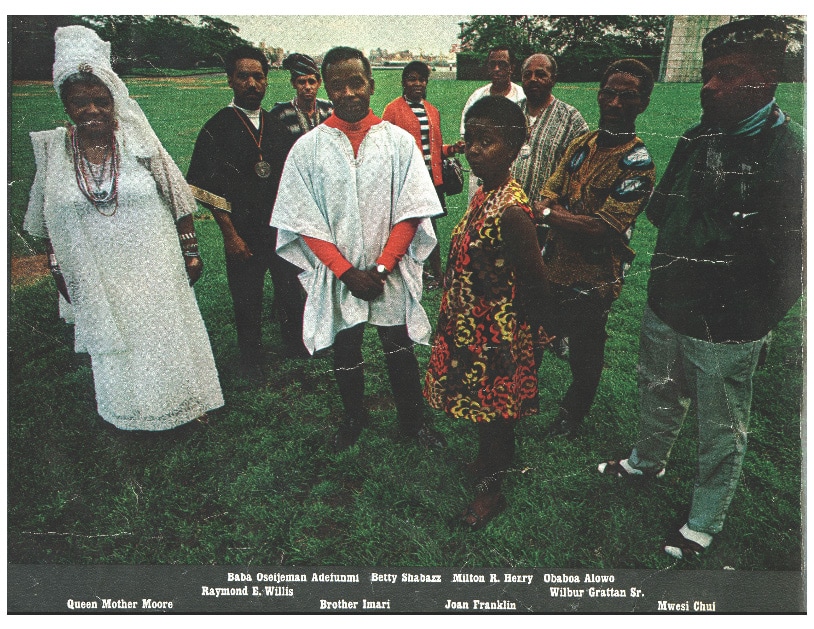
48 years ago a group of several hundred black nationalists from around the United States came together to assess what they had done when they created the Republic of New Africa - a group who decided to secede from the united states, seek reparations, land and the recognition of the black government (shown above in Esquire magazine).

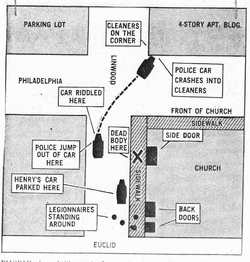
The group never finished the meeting because of what was called "the New Bethel Incident" which left 1 police officer dead, 1 officer injured, 4 republic members injured, new bethel baptist church (aretha franklin's father's church) shot up, approximately 150 people arrested/interrogated and then released (several of the events are depicted in the illustration below).
Picture
In a recent event at the Charles Wright Museum in Detroit, I talked about the New Bethel Incident as well as how I came to study it.  It was interesting to move back through the relevant events as they were central to my last book: "How Social Movements Die: Repression and Demobilization of the Republic of New Africa." This piece took a while to complete and I thought that it uniquely explored a question that we do not know much about: is it repression and/or participants that destroys a social movement organization?For this I leveraged access to a unique database of RNA as well as anti-RNA activity by the day and often the street address over a 4-year period.  While insightful, I think that the book tried to strike a balance between social science and detailed history which was hard to navigate: those interested in the history did not want to read the social science and those interested in the social science did not really want to read about the history or about some black folk that they did not believe were relevant to the cases that they were interested in.  I am systematically beginning to assess how the book was/was not cited and comparing it to other books that have come out on similar topics.  I think there are some broader issues involved which influence the reading and reception of the book.  

After reflecting, I have decided to split genres.  I have a draft of another RNA book that more directly dives into the social science camp.  And, I have begun to work on a manuscript that will attempt to simply tell the story of the RNA in a more direct/compelling manner. I'll keep you in the loop as these progress.


Actually, as the 50th anniversary of the RNA approaches and inspired by my recent revisitation, I am going to revisit the events that led this group of African Americans to follow the secessionist/internal exit option. The group finds its origins within the 1967 rebellion in Detroit and thus in July I will begin my 50-year retrospective.  The series will be called "Black to the Future: A 50 Year Retrospective of Why and How Several Hundred African Americans Tried to Create a Black Nation".   
2 Comments

Cross-post from Caveat Civis @ StateRepression.com: Trump & the Domestic Democratic Peace by Piece, Part 4

3/26/2017

0 Comments

 
Picture

Democracy is Beautiful (Not Messy)

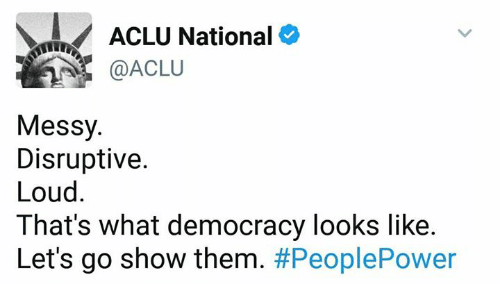
I recently saw that the ACLU remark that "democracy was messy" and (paraphrased) we should be ready to make it a bit messier in countering policies/actions that we might not like.  While looking for the source of this quote, I found that this is not a new message for the ACLU.  They have occasionally made this remark: 
  • "We all know that Democracy is messy and inefficient and slow and frustrating, but it has worked better than any other political system" in 2009 
  • "Democracy is messy and freedom of speech and assembly are not just exercised when it is convenient" in 2015
​​They are not the only ones:
The "Democracy is messy" (you need to break some eggs to make an omelet) trope is a bit dangerous however for Americans do not seem to like messy.  Nor do many other citizens within democracy for that matter.  Rather, most people like some degree of order, certainty and calm.  

Now, before I get misquoted/misunderstood, I think preparing folks for some "messiness" is a good thing.  By this I mean conflict/contentious politics/disagreement/discussion/back and forth.  It is better to prompt reasonable expectations about what could take place.  I'm thinking we need to get Schoolhouse Rock! back together to create some video for it (can you see it: "Protest is the Magic Action", "Ready or Not, Here WE Come" and "I'm Just an Indictment").  This said, we must be leery of the population that would be put off (or on) by such rhetoric.

As discussed in my Domestic Democratic Peace book, political repression (i.e., restrictions on civil liberties like limitations on speech/association as well as personal integrity violations like arrest/torture) is generally diminished by political democracy UNLESS there is some threat in the relevant nation-state.  Under these circumstances, repressive behavior is likely to go up in part because the citizens are not believed to object to such a thing.  In fact, they are likely to support it.  Invoking the "messiness" of democracy, I would argue, plays to this phenomenon and should therefore be used carefully if at all.

Actually, I would suggest that democracy is not messy.  It is beautiful.  For example, many tend to think of America under President Trump as some hierarchically structured system where the different parts of the political system line up underneath the President (this is symbolized by the 5 gold christmas balls below - who doesn't love christmas, right?).
Picture
In the conventional view, the President runs the government and all the other sections come in line - following the initiative of the leader.  Here, the President basically answers to no one and they gloriously do what they wish as depicted in the famous Charlie Chaplin scene below (perhaps one of the best scenes in film ever):
Clearly, this has not been the case.  Actually, what we are seeing is something more like the image below with the various parts of democracy lining up next to one another:
Picture
This is democracy at its finest - not messiest, mind you, but most beautiful.  In this context, we see that if one ball of the democracy (the executive for example) attempts to move upward/downward in a direction that is not believed to be favored by others (e.g., putting forward a ban on travelers coming into the US), then another ball of the democracy (e.g., a federal or state court, the media or the citizenry) kicks in to respond to the offensive behavior (respectively with a ruling, an article or a protest).  

​Of course, the executive in the example might try again and another part of the democracy might yet again step up but this is when/where the other balls can start responding.
 ​
What is interesting about the vid is that for the one section where the one ball is bouncing by itself it just seems kind of lonely, out of sync and a bit sad.  Stay beautiful democracy!
0 Comments

Cross-Post from "Caveat Civis" @ Staterepression.com: Trump & the Domestic Democratic Peace, Part 3

3/5/2017

1 Comment

 
Picture
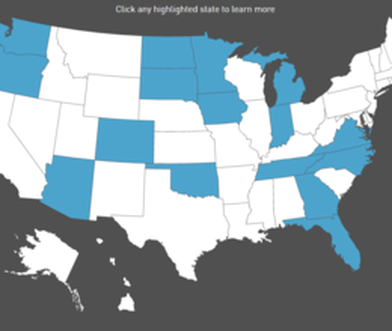
States where anti-protest bills are being put forward
Is There a New War on Protest?

Recently the ACLU put out some information that suggested that political protest is under assault and implicitly they are suggesting that the current US government as well as the sentiments that they have provoked by it, have led to this.  While this is an interesting proposition and clearly newsworthy, it is somewhat ahistorical and maybe a little alarmist.  There has been a longer term war on protest and protestors in the United States that extends back several decades now and the current wave with its bizarre qualifications (i.e., participating in "violent riots" in Oregon  or hitting protestors with a car in Tennessee - who is for these?), is just a bit odd to focus on.    Indeed, the only thing that has probably changed in the anti-protest stance of US political officials is the tactic being employed.

Things kind of get started in the 1960s (as many things repressive in the US).  At that time, government responses to protest were largely aggressive and often violent.   Researchers refer to this approach as the "escalated force model" — a strategy known by five distinct characteristics:
  1. Limited concern with the First Amendment rights of protesters and police obligation to respect and protect those rights;
  2. Limited tolerance for community disruption;
  3. Limited communication between police and demonstrators;
  4. Extensive use of arrests as a method of managing demonstrators ; and,
  5. Extensive use of force in order to control demonstrators.
This model of protest policing later gives way to a more "negotiated" and peaceful style whereby those engaged in dissent need to seek permission to protest through permitting, there is a discussion of what is going to take place and what will not be allowed to take place and challengers were subject to a mode of control that was more akin to death by a thousand paper cuts than bullets.  Note that this change takes place only after the most radical claimsmakers/making had been eliminated from the scene (e.g., gone are calls for nationalization, redistribution and an end of profit).  

Now, this is not to say that the state treated challengers any more kinder and gentler.  In a paper written a few years ago, entitled "Velvet Glove, Iron Fist, Or Even Hand? Protest Policing in the United States, 1960-1990", we discover that when challenged in a substantive manner (i.e., when the claim/objective is radical, when property is damaged, when tactics are highly confrontational), the US government is more likely to respond with aggressive and violent tactics.  In this regard, there was no change in how governments policed protest.  Invoking Bob Marley, when somebody moved (in a particular way), they got hurt - the same as it ever was.

Although not tremendously well documented, I recall reading about the reduction of spaces being made available for protest on US campuses throughout the country.  Indeed, at one point, I had a class assignment to find the protest zones available for 20 American Universities over time and it turned out that all of them had the sheer number of places reduced and the locales were generally moved to places with the smallest amount of traffic.  Protest was simply being made more convenient and less threatening.  

But, this is all par for the course in a democracy.  There are many people who might be in favor of free speech, assembly and protest but there are a great many who are not in favor of these - especially, if they do not particularly care for the messages being put forward.  What is alarming however is that we know very little about the effects of such shifts on subsequent challenges.  We do not know about the short, medium and/or longer term effects of such activities.  Some were excited to see protests associated with the Occupy movement, Black Lives Matter and the global action of woman around the world to show dissatisfaction and solidarity but these activities were few and far between.  Additionally, the objectives of these movements and the effectiveness of the relevant activities were not always clear.    

While I am one to quickly identify when governments are engaging in restrictions of civil liberties and personal integrity violations, we should be cognizant of larger trends as well as other questions regarding freedom that emerge.

Relevant reads:

Kraska, Peter B., and Victor E. Kappeler. 1997. “Militarizing American Police: The Rise and Normalization of Paramilitary Units.” Social Problems 44(1): 1-18.

McCarthy, John, and Clark McPhail. 1998. “The Institutionalization of Protest in the United States.” Pp. 83-110 in The Social Movement Society, edited by David S. Meyer and Sidney Tarrow. Boulder, CO: Rowman and Littlefield Publishers.
1 Comment

Cross-Post from "Caveat Civis" @ Staterepression.com: Trump & the Domestic Democratic Peace, Part 2

3/5/2017

1 Comment

 
Picture
Terrorists To The Left Of Us, Criminals To The Right, Oh My....
​

What's a threat and what's threatening to political authorities and citizens?  My 1995 piece on the topic entitled "Multidimensional Threat Perception and State Repression", which has informed much of my thinking on the topic, argued that authorities are threatened by specific behavioral manifestations of collective action: e.g., the degree of violence involved, the variety of different tactics being employed by challengers and the deviation of existing behavior from cultural norms/expectations (largely determined by prior experienced).  
While presenting a useful way to think about how governments conceive of threats as they think about using repressive action, however, this work treated threats as though they were publicly understood.  This was reasonable given the use of media generated data (i.e., the World Handbook of Political and Social Indicators): government responded to what was publicly known.  But, what about those threats are not publicly known?

President Trump says he has information that we are threatened.  To quote him directly: "While I’ve been president, which is just for a very short period of time, I’ve learned tremendous things that you could only learn, frankly, if you were in a certain position, namely president,” he said. “And there are tremendous threats to our country."  This raises some interesting questions though. What "things" is he talking about?  What evidence backs these things?  And what is new?  Did Former President Obama see this evidence but did not act, leaving us at risk?  Can Obama tell us his opinion about these "tremendous things" to get some corroboration or did he sign some agreement that he would not?  

This leads to still other questions: Why should we believe the current president or any president for that matter?  We have been misled before.  Remember discussions regarding weapons of mass destruction from former President Bush, Soviet superiority in nuclear weapons across numerous US administrations or that there were Communists under every rock? These were all falsehoods that cost American lives and money.

Why are we back here again and what does it mean for those of us interested in state repression and human rights?Well, fear is big business and it is one that is immensely important for political authorities. But herein lies the biggest weakness in a democratic form of government: the people with the information about what threatens the citizenry and polity are the same people who have a vested interest in providing protection from said threats.  This is the essence of the "protection racket" discussed by Charles Tilly and William Stanley.  Societies cannot rely upon the agency that has a vested interest with providing protection to generate information on the very threats that prompt/legitimize threat protection.  

In a sense, we should "publicize" not privatize threat assessment (in diverse senses of the word).  Transparency, reliability and validity require it.  Why not have some panel of relevant scholars provide assessments and let these be publicly vetted for reasonableness from another set of scholars?  At this point, I am not even suggesting having all this information be released to public.  Folks could sign away rights to talk about what they see for a few years but they would provide some check.  After 10 years this info is released to the public. 

Threat assessment is too important for political democracy for its evaluation and process to be hidden from public view.  What criteria are used for good information?  How many sources were used?  How credible are the witnesses?  Are there witnesses?  How much error is included within the threat assessment (there is always error)?  How "tremendous" is tremendous? - I need some kind of baseline.  Is it Grand Canyon tremendous or is it strawberry milkshake after a few years kind of tremendous? 

I say this in part because the part about crime and people being threatened by it is just kind of wrong.  

If people are not actually being threatened by crime, however, then it might be possible that we are not really threatened by terrorism/terrorists either.  In that context, President Trump is playing to an old dynamic within American politics: the politics of fear/fearing up.  The minute this is done however, the peace and lowered repression that is normally associated with democracy, is undermined as discussed in my Domestic Democratic Peace book.  In this context, where it is believed that some threat is apparent, then the path to repression is facilitated.  


1 Comment

Cross-Post from "Caveat Civis" @ Staterepression.com: Trump & the Domestic Democratic Peace, Part 1

3/5/2017

0 Comments

 
The Immigration Act: Repression Somewhere Between IR, Comparative & American Politics 

Observers and students of state repression quite frequently ask about what is/is not included within the concept.  There is also some interest in trying to demarcate whether something is domestic in orientation (either under American politics or comparative politics) or international.  The new immigration order put forward by President Trump a few days ago reveals that there are some policies that are all of these things.

As I stated in my review of the repression literature a few years ago (State Repression and Political Order):


By most accounts, repression involves the actual or threatened use of physical sanctions against an individual or organization, within the territorial jurisdiction of the state, for the purpose of imposing a cost on the target as well as deterring specific activities and/or beliefs perceived to be challenging to government personnel, practices or institutions (Goldstein 1978, p. xxvii). Like other forms of coercion, repressive behavior relies on threats and intimidation to compel targets, but it does not concern itself with all coercive applications (e.g., deterrence of violent crime and theft). Rather, it deals with applications of state power that violate First Amendment–type rights, due process in the enforcement and adjudication of law, and personal integrity or security. 

First Amendment–type rights include (Goldstein 1978, pp. xxx–xxxi): 
  •  Freedom of speech, assembly, and travel. Freedom of the press up to a very narrowly defined “clear and present danger” point, regardless of the views communicated. 
  •  Freedom of association and belief without governmental reprisal, obloquy, or investigation unless clearly connected with possible violations of existing laws. 
  •  The general freedom to boycott, peacefully picket, or strike without suffering criminal or civil penalties. 
Due process transgressions involve violations of “generally accepted standards of police action and judicial and administrative behavior related to the political beliefs of the person involved” (Goldstein 1978, p. xxxi). Personal integrity rights are those concerned with individual survival and security, such as freedom from torture, “disappearance,” imprisonment, extrajudicial execution, and mass killing. 

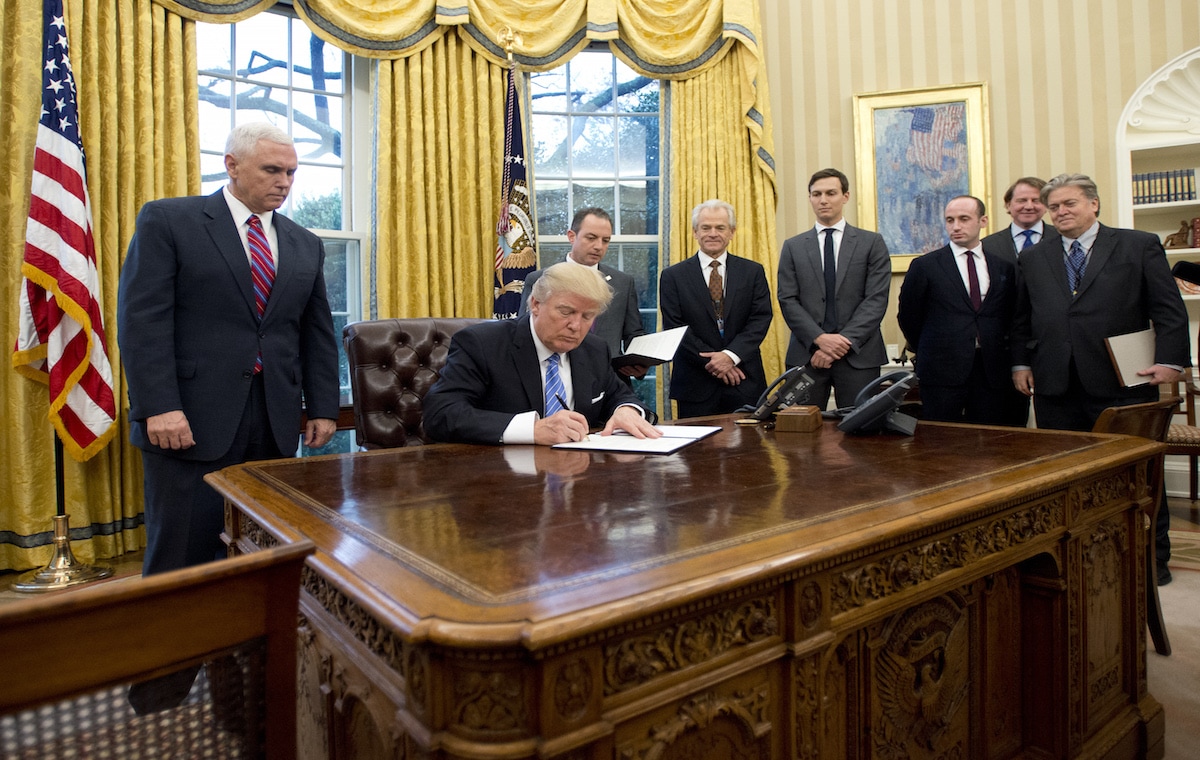
​Within this context, the current ban is "repressive" in that it uses the actual or threatened use of physical sanctions against individual or organization (i.e., forced detention) and the threat of such (e.g., incarceration, removal from the country). This is taken against people from the United States in order to influence individual behavior as well as the expression of beliefs.  Now, the activities might not seem that problematic as they are presumably to counter terrorism but it is not clear exactly how the US government would know this and the criteria for a terrorist has never been provided.  In a sense, the activities here would simply be more indiscriminate than they would be selective.  I am presuming that deep "vetting" (discussed by President Trump) would only be able to reveal associations and prior actions.  It is not clear how this would be figured out however.  Additionally, there has been no discussion of reading into people's brains/minds and/or gauging future activity like in the Minority Report with Tom Cruise.  If the precision of the crime and its detection could be established, then this would fall outside the parameters of state repression.  The open-ended nature of the designation is key.

While attempting to influence people living in the country (e.g., green card and visa holders) is clearly within the domain of state repression, the attempted influence of people from other countries is a different matter.  The latter makes the action international and I will leave the proper designation/label to those that have interest in such things.  I just highlight that it is not what we common think of as state/political repression.  Perhaps we need to start using the phrase "international state repression" to designate such behavior (couldn't help myself). Perhaps IR and American colleagues should work this out so we have an idea what each is talking about.  

The complexities from the ban are clearly worthy of attention.  For example, they reveal how actions from a single political authority can simultaneously have both domestic and foreign implications.  They reveal how actions from a single political authority can prompt both behavioral challenges both within the relevant territorial jurisdiction as well as across different territorial jurisdictions.  Regarding the former (a frequently neglected aspect of democratic governance), it will be interesting to figure out why certain airports engaged in dissident activities while others did not. It will be interesting to figure out how tactics were selected (e.g., marches, sit-ins, shut-downs) and which ones were considered but not employed. It will be interesting to figure out whether the places that put forth behavioral challenges at the airports are the same places where protest normally kicks in.  

It is also interesting that the actions of the executive have prompted still other aspects of democracy to take action (e.g., civil society organizations like the ACLU and the Federal District court).  Indeed, the swiftness with which the initial legal actions were taken, the court respond and the action countered was quite something.  That said, the ban is said to still be in effect.  This should prompt investigations into what repressive actions could be countered by what strategies and also what sequence of actions need to undertaken to stop policies before they are enacted, monitor the actions as they are rolled out, halt them after they are underway as well as counter-act spinoff repressive policies that emerge after the first one.  

Clearly the ban has issued a call to action across various divides but it is also a call to build intellectual bridges as well. The ban prompts Americanists, IR scholars and Comparativists to communicate with one another.  It prompts people with interests in the subfields of contentious politics, state repression and political democracy to communicate with one another. The ban also prompts political scientists to talk with sociologists, legal scholars, public policy experts, communication scholars, anthropologists, historians and a whole list of people.  In short, democracy is about to get a run for its money folks.  Strap yourselves in for a wild one.
0 Comments

    Analog - The Anti-Blog

    By "Analog" I am referring to the adjective (i.e., relating to or using signals or information represented by a continuously variable physical quantity such as spatial position or voltage) and not the noun (i.e., a person or thing seen as comparable to another) for I wished to give voice to my thoughts which have come to me in a more or less continuous manner but which do so in a way that is not consistent in content or form. Thus you will see short stories, brief thoughts, haikus, low-kus and even a political cartoon or two. 

    Winner of Best Blog Post for 2014 by International Studies Association

    Picture

    Archives

    December 2025
    May 2024
    April 2024
    November 2023
    December 2022
    October 2022
    March 2022
    February 2022
    May 2021
    April 2021
    January 2021
    August 2020
    July 2020
    June 2020
    May 2020
    May 2019
    April 2019
    March 2019
    May 2018
    April 2018
    March 2018
    February 2018
    January 2018
    July 2017
    June 2017
    May 2017
    April 2017
    March 2017
    February 2017
    December 2016
    November 2016
    October 2016
    September 2016
    July 2016
    June 2016
    April 2016
    March 2016
    February 2016
    January 2016
    December 2015
    November 2015
    September 2015
    June 2015
    May 2015
    April 2015
    March 2015
    December 2014
    September 2014
    March 2014
    February 2014
    January 2014
    December 2013
    November 2013
    October 2013
    September 2013
    August 2013
    July 2013
    June 2013
    May 2013
    April 2013
    March 2013

    Categories

    All
    Activism
    Art
    Black Power/nationalism
    Communication
    Counter-terrorism
    Data
    Database
    Education
    Elitism
    Ethnicity
    Fashion
    Friends
    Genocide
    Global Blackness
    Hip Hop
    Human Rights Violation
    Identity
    India
    Inequality
    Memories
    Norway
    Passing
    Political Conflict
    Political Tourism
    Political Violence
    Poverty
    Racism
    Republic-of-new-africa
    Research
    Revolution
    Rwanda
    Sexism
    Social Media
    State Repression
    Struggle
    Terrorism
    Travel
    United States
    Untouchability

    RSS Feed

Picture